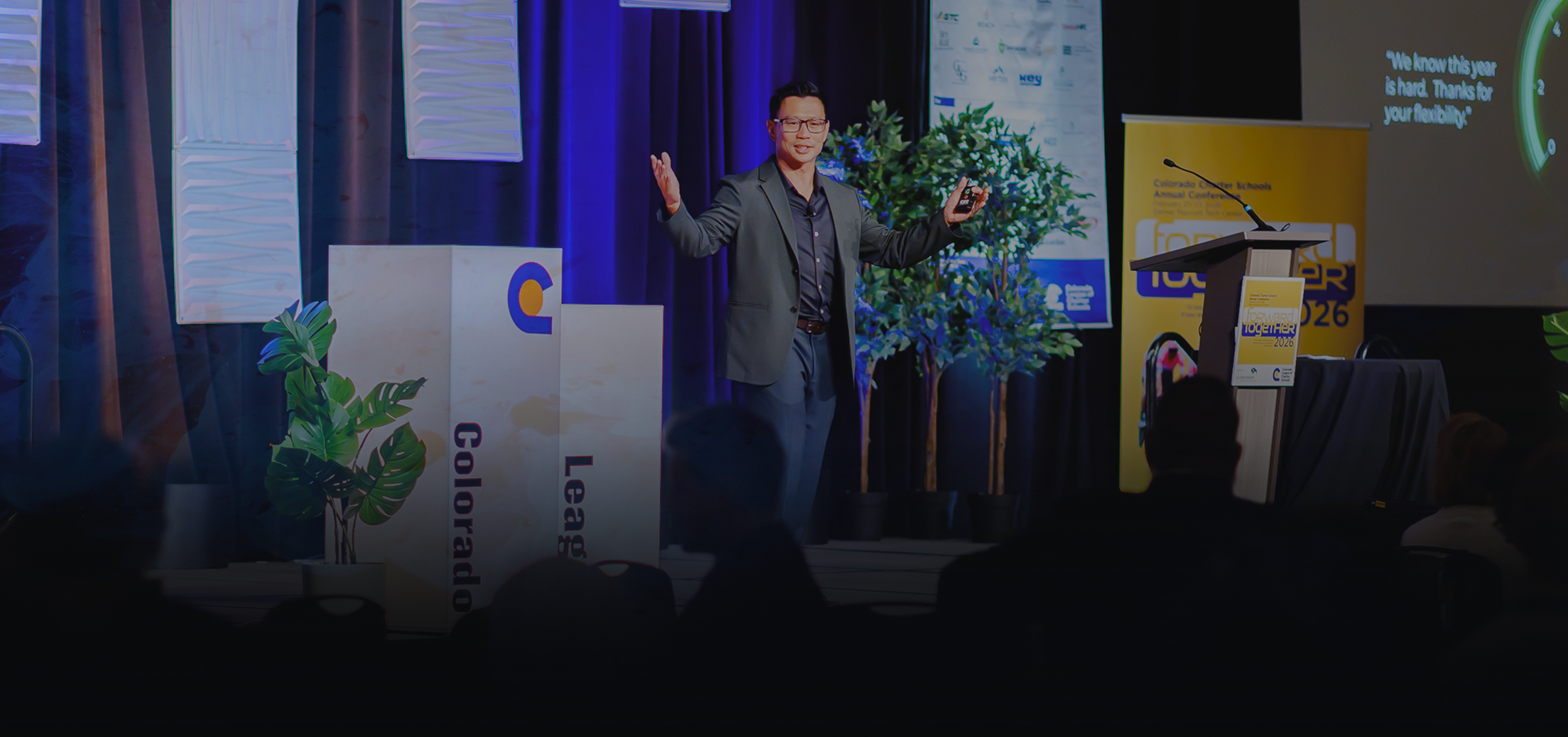
A keynote your team
doesn't just attend.
They practice.
Newton Cheng turns leadership ideas into live experience.
Your audience won't leave with something they hope to try later. They'll have already practiced it together, in the room.









Choose the depth your audience needs.
Keynote
01
For conferences, all-hands meetings, leadership events, and company gatherings.
45–60 minutes
Workshop / Breakout
02
A deeper facilitated experience for leadership teams and intact groups.
Half-day
Same capability. Different depth.

Strategic Vulnerability
Expand collective intelligence, improve decision quality, help your organization thrive under pressure.
What happens when leaders create the conditions for people to say what actually needs to be said? Newton teaches Strategic Vulnerability as a practical, learnable leadership capability, then gives the room a chance to apply it.
Participants experience how a different kind of conversation can surface risks, challenge assumptions, and build trust before the stakes get higher.
This isn’t vulnerability for its own sake. It’s practice for the conversations your organization can't afford to avoid.

What Happens During the Talk
The audience realizes.
Participants see where self-protection is hindering conversation.
Newton goes first.
He models Strategic Vulnerability before asking anything of the audience.
They do the reps.
Participants practice the capability with each other.
The conversation shifts.
They experience what changes when people share more of the truth.
They leave ready to repeat it.
The audience walks away having practiced new behaviors, not just learned new frameworks.

What Changes After the Talk
Outcome

Faster decisions
Earlier risk identification
Stronger trust
Better information
More resilient teams
What it looks like
Less time circling around what nobody wants to say.
Problems surface while there is still time to act.
People become more willing to raise concerns and challenge assumptions.
Leaders hear more of what their teams actually know.
Leaders learn who needs support before a crisis hits.

Who This is For

People agree in meetings and raise concerns afterward

Leaders keep getting surprised by problems their teams saw coming

A reorg, layoff, or leadership change has left people guarded

AI and rapid change are creating uncertainty across the organization

Psychological safety is discussed more than it is experienced

Leaders want more candor without simply telling people to "speak up"
Fear is already costing you.
Psychological safety was the single strongest predictor of team performance, according to Google's own internal research.
Only 45% of workers say they feel safe sharing their honest opinions at work.
Only half of employees say their managers actually create psychological safety on their teams.

Why Newton
Newton spent seventeen years at Google, held an executive leadership role, and was a two-time award winner for facilitation excellence
That experience taught him how to work with skeptical senior audiences, create meaningful participation, and push a room far enough to make the conversation useful without pushing people so far that they shut down.
His background as an electrical engineer and world champion powerlifter shapes the rest of his approach:
Understand the system. Do the reps. Leave with a new capability.


What People Say

Different challenges. The
same focus on how people
perform under pressure.
01
Wellbeing Programs and Campaigns Aren't Enough
17 Years of Lessons Learned from Google
Most top organizations already invest in employee wellbeing. The harder question is whether those investments are changing the way people actually work. Newton shares what he learned leading health and wellbeing inside Google: what worked, what didn't, and what organizations miss when wellbeing remains a program instead of becoming part of how the business operates.
Best for organizations asking: Why are people still struggling when we're already investing in wellbeing?
Audiences leave with:
- A clearer understanding of what drives employee wellbeing
- A stronger connection between wellbeing and business performance
- Better criteria for deciding which programs deserve investment
02
The Moment That Broke Our Leadership Playbook
Mental Health Leadership in the Age of AI
Leaders have traditionally been expected to have the answer. That becomes much harder when the environment is changing faster than anyone can reliably predict. Drawing on his experience leading through organizational change and AI-driven pivots at Google, Newton explores how leaders can remain credible without pretending to be certain.
Best for organizations asking: How do we lead people through change when we don't know exactly what comes next?
Audiences leave with:
- A better way to lead through uncertainty
- Key leadership pitfalls to avoid when you can't anticipate the future
- Stronger trust during periods of disruption
03
Doomed Before Launch
Uncovering the Hidden Blockers to Innovation
Sometimes the people who could have saved the project saw the problem months ago. But they never said anything. Drawing on his experience leading innovation projects inside Google, Newton explores why concerns, resistance, and weak assumptions often surface too late.
Best for organizations asking: Why don’t people raise concerns before a change is implemented, but quietly resist the change afterwards?
Audiences leave with:
- Insight on how innovation projects break down before implementation
- Practical approaches to discover what your project actually requires to be successful
- Stronger trust . . .
Speaker Resources
- High-resolution headshots
- Speaker one-sheet
- Full biography
- Stage introduction
- Speaker package